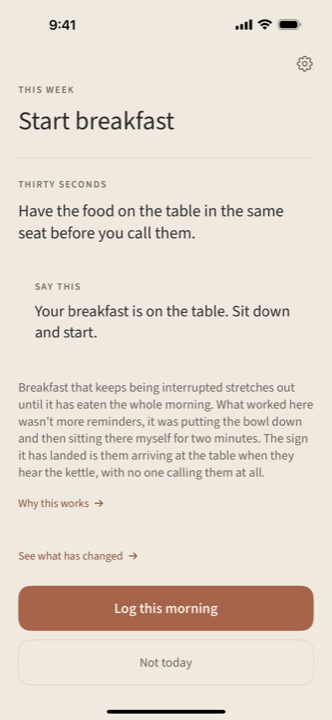
Every Age is not another chart.
Pick one thing. Shoes. Teeth. The school bag. A thirty-second setup the night before, one sentence to say out loud, a short check-in to say how it went. After enough check-ins we compare them to the two you started with, and say whether the reminders, the stepping in, or the conflict went down. If they did not, we say that.
For children roughly 4 to 10. A tool for the adult: no child ever opens it, and there are no child accounts.
Five routines
Which part of the day is hard
Every step is one small thing, in one routine, practised for a week. These are steps from the app, each with its own age window inside 4 to 10: the app only offers a step when it fits the age you gave, and some below start at five, six, or eight rather than four.
-
Morning
One call, at the same time, and no second or third; clothes waiting on the chair, put on without an audience; a school bag packed by them, and not in the doorway by you.
-
Evening
Pyjamas on by themselves and the day's clothes in the basket, tomorrow's clothes chosen and laid out without being told, and the screens they have on the charger downstairs at the agreed time, without being chased.
-
Homework
The planner read first and what's due said out loud in one sentence, books out and started at the agreed time, and one thing tried before the question comes with the stuck bit named.
-
Mealtimes
Called once, and they walk to the table themselves; water poured from a small jug into their own cup; their plate and cup carried over once the chair goes back.
-
Out the door
Into their own seat and the buckle clicked by them, the same short goodbye every time, and the stretch from the school gate to their classroom walked without you.
-
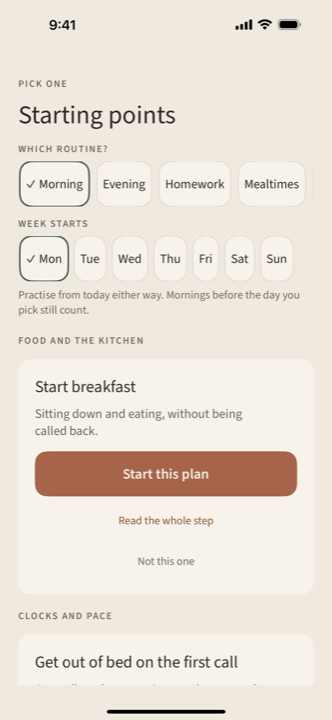 Pick one step.
-
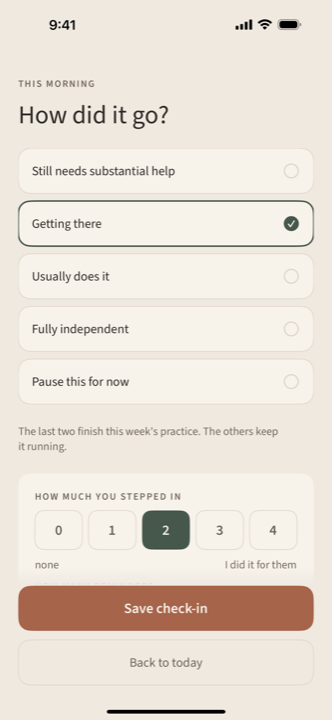 Say how it went.
-
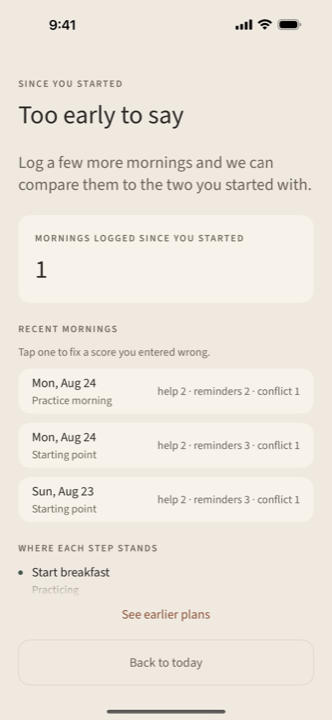 See what changed.
Looking ahead
The same conversation from four to ten
There is a different question from the morning loop: how many activities, how many hours, and how would you know it is too much. Looking ahead answers it for the age your child is now, and shows the years from four to ten with this year marked. You can save this week's picture whenever you want.
Nobody knows the right number of activities and we will not pretend otherwise. What the app can describe is the shape of a week if they want one, the signs a parent would actually notice when the week is too full, and the one hard edge worth holding: hours a week in a single activity should not go past the child's age in years. The number comes from training guidance written for young athletes already committed to one sport, and treating it as the edge for a whole week is our call, not a pediatric standard. That is a limit rather than a target. Sitting at none is still a complete week, and this is not a schedule you have to follow.
What this is based on
Written in-house, and said plainly
The steps and the numbers are our own work, written and checked in-house by the people who make this app. It is not clinical guidance, it has not been trialled, and nobody outside our team has reviewed it. Where a routine sits close to health, the app says so on the screen and points you at your doctor.
It makes no claim about what any child should be able to do at any age, and it is not medical, psychological, or educational advice. It does not assess or identify anything.
No points, no streaks, no stars, no badges, no confetti. A celebration animation at 6:45am on a hard morning is an insult, so there is not one anywhere in this app. A missed check-in is a missed check-in: nothing is lost, nothing is taken away, and the app never frames your child as a problem. You can turn on one reminder a day for the plan you're running, timed to that routine. The weekly Looking ahead reminder and your plan reminder are optional, and you turn those on yourself.
Pricing
Free to download
Age pages, quizzes, and every week of practice stay free. The family plan is $6.99 a month or $59.99 a year: every child beyond your first, and earlier years of your birthday and first-day interviews. It renews until you cancel in the Settings app, or at https://apps.apple.com/account/subscriptions. Apple sells and bills it, and Apple handles refunds under their terms. Deleting the app does not cancel a subscription.
Your data is yours. Export it or use Delete my account and all data from inside the app, without contacting anyone.